Suite 317
A Gentleman in MoscowSuite 317 is Count Alexander Ilyich Rostov’s former apartment at the Metropol, a sequence of connected rooms whose space and windows make it more than a lost address. It becomes a measure of what confinement has taken from him: not only grandeur, but the room for an ordinary, self-directed hour. At once a coveted vantage point, a private domestic interior, and a suite occupied by strangers, it gathers the hotel’s changing life into a single place.
Former Apartment and Position in the Hotel
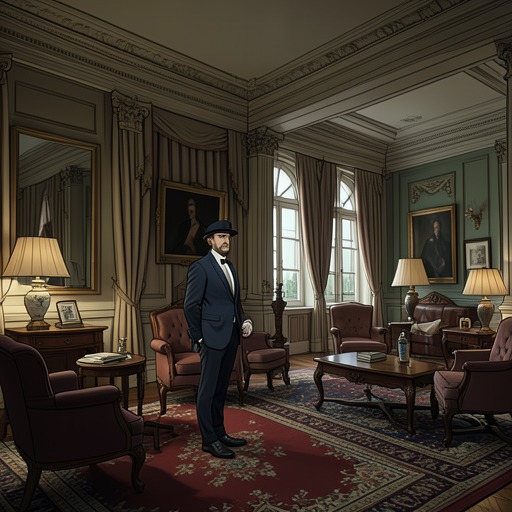
On the third floor, a red-carpeted hallway leads to the Count’s suite, which comprises an interconnected bedroom, bath, dining room, and grand salon. Its eight-foot windows overlook the lindens of Theatre Square. The apartment’s scale and arrangement belong to a life built around several rooms and distinct uses, rather than the single cramped space later assigned to the Count. When he returns, the suite still contains features that make it recognizable as his former home, even though its open doors and new occupants mark that it is no longer his.
The return is not a simple homecoming. The Count encounters the suite with a palpable sense of foreboding, and the scene makes the familiar interior newly strange: furnishings from his former life remain among signs of someone else’s present. The contrast between continuity and displacement is central to the room’s significance. It has not vanished or been destroyed; instead, its continued availability to other residents makes the Count’s loss visible.
Nina’s Vantage Point
Nina’s exploration of private apartments is motivated by their views, not by an attempt to steal or snoop. Each room offers a different prospect, shaped by its height, orientation, season, and time of day. From room 322, one can watch battalions marching toward Red Square on the Seventh of November; room 405’s deep window ledges suit the dropping of snowballs on unsuspecting passersby; and room 244 offers a view of fruit sellers gathering by the kitchen door, where an apple may occasionally be tossed up. The hotel’s rooms are thus differentiated by what they let a watcher see and by the small actions their outlooks make possible.
For watching guests arrive at the Bolshoi Theatre on a summer night, Nina identifies Suite 317’s northwest window as the best vantage point. On July 12 at seven o’clock, she signals to the Count in the lobby. Two minutes later he has joined her on the stairs and follows her past rooms 313, 314, and 315, through the door she unlocks. From the northwest corner, they look across Theatre Square at the illuminated theatre. As its guests begin going inside, a taxi arrives; a woman in red leaps out and runs up the steps, holding up her dress. The window frames a brief, vivid entrance into another world of evening ceremony, while the Count watches from a room he once possessed and no longer inhabits.
A Room’s Ordinary Afternoon
On reacquainting himself with the suite, the Count recognizes the red-upholstered couch and chairs, his family’s grandfather clock, and the large Chinese urns from Idlehour Estate. A French coffee table, supplied to replace his grandmother’s, now holds a folded copy of Pravda, a silver service, and an unfinished cup of tea. These objects place inherited furnishings beside evidence of a current resident’s routine. The newspaper and tea do not announce a dramatic event; their force lies in how readily the Count can imagine the ordinary sequence that produced them.
Later, alone on his bed, he finds that the tea service beside the folded paper has stayed with him more than the architecture, the view, or even the clock still ticking by the door. From those modest objects he reconstructs an afternoon: the resident has returned from an outing at four, hung up his jacket, called for tea and an afternoon edition, and settled onto the couch for a civilized hour before dressing for dinner. The scene he reads in Suite 317 is therefore not merely an afternoon tea. It is the visible shape of a gentleman’s daily life at liberty.
Against that tableau, the Count reassesses his own assigned room: one hundred square feet in which the bed crowds the coffee table, the coffee table crowds the high-backed chair, and the chair must be pushed aside whenever the closet is opened. The comparison is concrete rather than abstract. Suite 317 accommodates an unhurried interval between returning and dressing; the Count’s small room cannot accommodate the same ease. Its former spaciousness makes the limits of his present life newly legible.
Occupancy, Displacement, and Narrative Role
Suite 317’s meaning changes with its occupants. The Count once lived among its connected rooms and recognizable furnishings; Nina later uses its northwest window as a privileged viewpoint; and the room’s tea service belongs to a resident whose freedom the Count can imagine but no longer share. Later, the desk captain explains that Secretary Tarakovsky is now staying in the suite. A gentleman has gone there looking for the Count, challenged Tarakovsky’s right to occupy the apartment, and searched its rooms, including the bathroom, before demanding to see the manager. The Count learns that this intruder is the person seeking him.
That episode turns the apartment’s changed ownership into an active source of confusion. The intruder behaves as if Suite 317 should still lead him to the Count, while the current resident insists that it is his own suite. The room has become a point where an earlier claim and a present occupation collide, and where the Count’s past remains sufficiently visible to draw someone searching for him. Across its successive scenes, Suite 317 connects spectacle outside the window with private routine inside, and intimate memory with the hotel’s unsettled present. Its rooms preserve enough of the Count’s former life to let him recognize what has been lost, but their continued use by others confirms that recognition is not restoration.